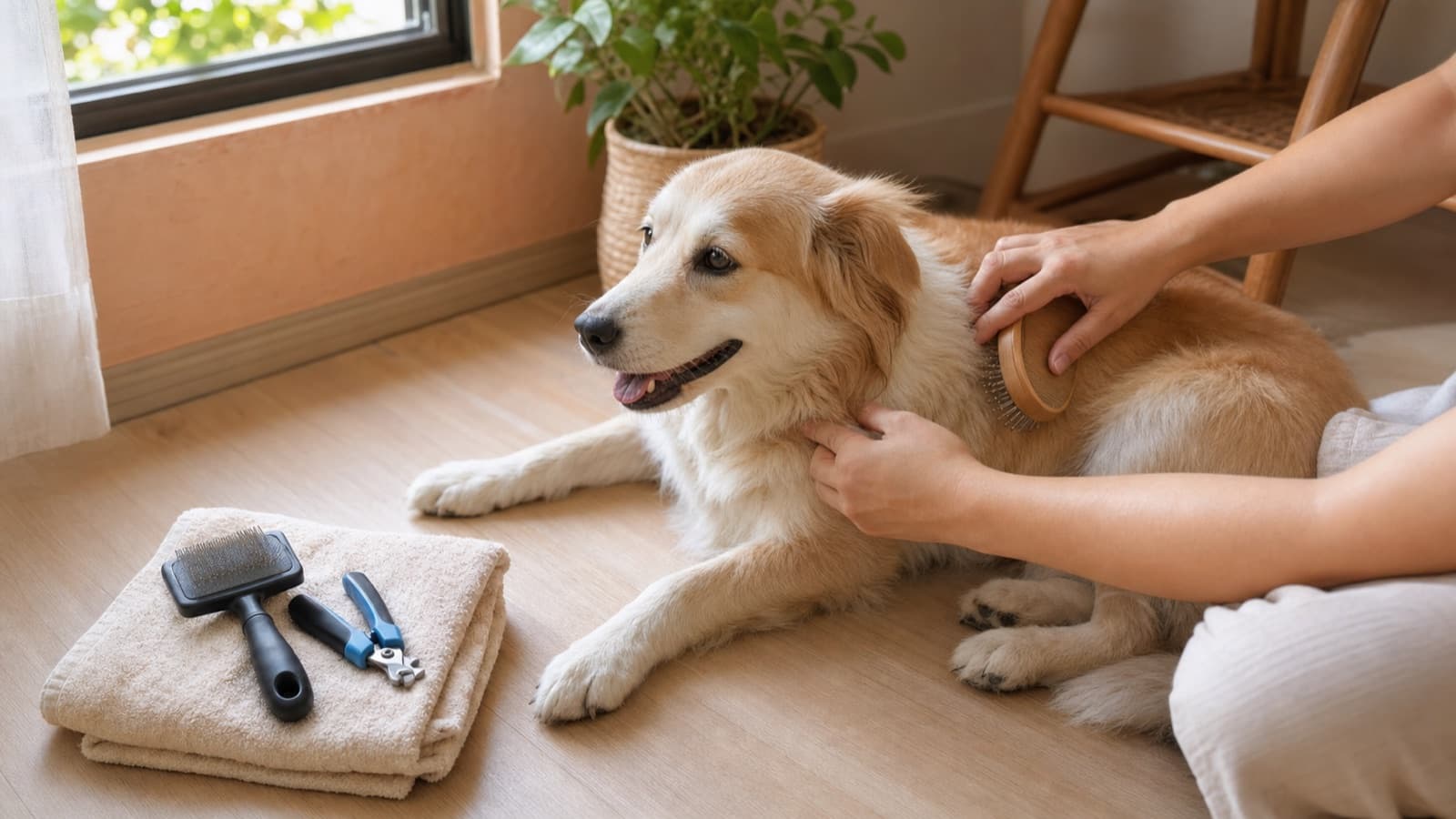
Home pet care tutorials are not a replacement for professional grooming. They are the daily and weekly habits that keep your dog comfortable, clean, and mat-free between visits to a groomer. In Metro Manila's humidity, the gap between grooms is where problems start: a coat left unbrushed for two weeks becomes a mat close to the skin, paws left dirty after a rainy walk start to smell, and ears left wet after a bath start to itch. This guide walks through the techniques that actually work at home, plus exactly where the home limit is and when to book a professional.
What Home Pet Care Tutorials Should Every Filipino Pet Owner Know First?
Every home pet care tutorial worth following covers the same ground: brushing, bathing, drying, nail care, paw and eye hygiene, dental habits, and handling. Skipping any one of these does not save time. It just moves the work to your groomer's table later, usually as a longer and more expensive session because the coat is matted or the nails are overgrown.
The order matters too. Brushing comes before bathing, because a wet mat tightens and becomes nearly impossible to remove without cutting it out. Drying comes before your dog is allowed to nap on the bed, because a damp undercoat left to air-dry in humid air is exactly the environment fungus and hot spots need. Treat each section below as a skill to build slowly, not a checklist to finish in one afternoon.
How Do You Brush Your Dog's Coat Based on Coat Type?
Coat type decides both your tool and your schedule. A short, smooth coat (Beagle, Aspin, most short-haired cats) sheds into the furniture more than it mats, so a rubber curry brush once or twice a week collects loose hair before it spreads. A double coat (Golden Retriever, a thick-coated Aspin) needs an undercoat rake two to three times a week, worked in the direction of hair growth in short strokes, to pull out the loose insulating layer before it packs down. A long, silky coat (Shih Tzu, Maltese) mats within days in humidity and needs a slicker brush daily, working in thin sections from the skin outward, not just over the top of the coat.
| Coat type | Example breeds | Brush type | Frequency |
|---|---|---|---|
| Short, smooth | Beagle, Aspin, short-haired cat | Rubber curry brush | 1 to 2 times a week |
| Double coat | Golden Retriever, thick-coated Aspin | Undercoat rake or slicker | 2 to 3 times a week |
| Long, silky | Shih Tzu, Maltese, Yorkshire Terrier | Slicker brush and metal comb | Daily |
| Curly or wool | Poodle, Poodle mix | Slicker brush and comb | Every other day |
For a full breakdown of exactly how often a silky coat needs attention in local humidity, see our guide on how often you should groom a Shih Tzu in Metro Manila's humidity. The short version: skipping even three or four days on a long coat is enough for a tangle to start.
How Do You Tell a Tangle From a Mat?
A tangle is loose. You can work a comb through it in sections, starting at the tips and moving toward the skin, and it separates without pulling. A mat is compacted fur that has felted into a solid clump. It does not separate with a comb. It tugs at the skin when you try, and your dog will flinch or pull away.
Never use scissors near a mat close to skin. A mat sits closer to the skin than it looks, and a dog that shifts even slightly while you are cutting can end up with a nick. If a mat separates with a slicker brush and comb worked in small sections, you can clear it yourself. If it does not separate after a few minutes of patient work, stop and book a professional groomer, who has the tools and the technique to remove it safely without a blade anywhere near the skin.
How Often Should You Bathe Your Dog Between Professional Grooms?
Most dogs do well with one bath every two to three weeks between professional grooms, and cats rarely need a bath between grooms at all. Bathing more often than that strips the natural oils that protect the skin, and in Metro Manila's humidity, over-stripped skin dries out and gets itchy faster than it recovers. An itchy dog scratches, and scratching is how a small irritation becomes a skin problem.
Never use human shampoo on a dog or cat. Human skin and pet skin have a different pH, and a human formula, even a gentle one, disrupts the coat's natural barrier and can leave the skin flaky and irritated. Use a dog- or cat-formulated shampoo, wet the coat fully down to the skin before applying it, and rinse until the water runs completely clear. Shampoo left in the coat is a common cause of the itching owners later blame on allergies.
How Do You Dry Your Dog Properly After a Bath?
A damp undercoat is the real enemy, not the bath itself. Towel-dry first to pull out the bulk of the water, then use a pet dryer or a hair dryer on the coolest setting, held at least 15 centimeters from the skin and kept moving constantly so no one spot gets too warm. Brush as you dry, section by section, so air actually reaches the undercoat instead of just drying the top layer while the base stays wet.
Check the ears before you consider the job done. Water and shampoo residue collect at the base of the ear canal, and in a floppy-eared dog that airflow is already limited, so trapped moisture sits there far longer than it does on an upright ear. If your dog has floppy ears, our guide on how often you should clean a floppy-eared dog's ears covers the routine that keeps that moisture from turning into an infection.
How Do You Trim Your Dog's Nails Without Hitting the Quick?
The quick is the blood vessel and nerve running through the center of the nail. On a light-colored nail it is visible as a pink line, so trim just before it, a small amount at a time. On a dark nail the quick is not visible, so trim in thin slices and stop as soon as you see a pale gray or chalky white dot appear in the center of the cut surface. That dot means you are close.
Never cut into the quick deliberately, and never rush a trim because your dog is squirming. If you do cut too far, the nail will bleed, sometimes more than the actual wound looks like it should. Press a clean cloth or a styptic pencil firmly against the tip for about a minute without checking every few seconds. If the bleeding does not stop within several minutes, or your dog is limping afterward, stop and see a vet the same day.
How Do You Care for Your Dog's Paws After a Rainy-Season Walk?
Rinse or wipe each paw with a damp cloth as soon as you get home, working between every toe where mud, bacteria, and standing water collect. Dry thoroughly, especially between the pads, since a damp paw left inside a warm house is where fungal problems start during rainy season. A dog paw balm afterward helps if the pads look dry or cracked from repeated wetting and drying.
Check the pads themselves while you clean. Look for cuts, embedded debris, redness between the toes, or a limp that was not there before the walk. Any discharge, swelling, or a limp that continues after a rest is not something to wait out. See a vet rather than guessing at what is causing it.
How Do You Clean Eye and Tear-Stain Areas on Flat-Faced and Long-Coated Breeds?
Flat-faced breeds (Shih Tzu, Pekingese, Persian cats) and long-coated breeds tend to tear more, and that moisture sitting in the fur under the eye is what causes the reddish-brown tear stain, not a health problem on its own in most cases. Wipe the area daily with a clean, damp cloth or a pet-safe eye wipe, moving outward and away from the eye, and dry it so the fur underneath is not left damp all day.
Keep the hair around the eyes trimmed short if your dog's coat grows long enough to poke the eye itself, since constant irritation from hair is a common cause of excess tearing. If you notice thick discharge, a red or swollen eyelid, or your dog pawing at one eye more than usual, that is beyond a wipe-and-dry routine. See a vet.
How Do You Build a Daily Dental Habit for Your Dog?
Daily brushing is the single habit with the biggest long-term payoff, and it is also the one most owners skip. Use a dog-specific enzymatic toothpaste, never human toothpaste, on a soft finger brush or a small pet toothbrush, and work in small circles along the gum line where plaque actually builds up. Start with just a few seconds a side and build up gradually rather than attempting a full two-minute brush on day one.
If daily is not realistic yet, three to four times a week still meaningfully slows tartar buildup compared to none at all. Dental chews and water additives help between brushings but do not replace brushing. Bad breath alone is common and not urgent, but red or bleeding gums, a loose tooth, or a dog that suddenly stops chewing on one side of its mouth means it is time to see a vet.
How Do You Desensitize a Puppy to Clippers, Water, and Handling?
Start weeks before your puppy's first real bath or trim, in short sessions of a few minutes, not one long one. Let the puppy sniff and see the clipper or nail trimmer while it is off, pair it with a treat, then turn it on nearby without touching your puppy at all, and reward calm behavior. Only after several calm sessions do you touch a paw with the off tool, then the on tool, building up in tiny steps.
Handle paws, ears, and the mouth for a few seconds at a time during ordinary play, not only right before a grooming task, so being touched there stops being unusual. Never restrain a panicking dog to finish a task. If your puppy is thrashing, stop, let them calm down, and try again later in a shorter session. Pushing through a panic teaches a puppy that grooming is something to fear, which makes every future session harder.
How Do You Build a Weekly Home Pet Care Routine You Can Actually Keep?
A routine that survives a busy work week beats a perfect routine you abandon after two weeks. Attach each task to something you already do: brushing while watching TV, paw-wiping right at the door, so it does not compete for a separate block of time.
| Day | Task | Time needed |
|---|---|---|
| Monday | Full brush-out, coat type dependent | 5 to 15 minutes |
| Tuesday | Paw wipe after walk, quick eye wipe | 2 minutes |
| Wednesday | Brush, check ears | 5 to 10 minutes |
| Thursday | Teeth brushing, paw wipe | 3 minutes |
| Friday | Brush, nail check (trim if needed) | 5 to 15 minutes |
| Saturday | Bath, every 2 to 3 weeks only | 20 to 30 minutes |
| Sunday | Rest day, spot-check coat and skin | 2 minutes |
Adjust the grid to your dog's actual coat. A short-coated dog can skip most of the daily brushing and lean on the Saturday and Friday slots, while an owner of a long-coated breed should treat the guide linked above on Shih Tzu grooming frequency as the realistic minimum, not the maximum, since humidity does not wait for a convenient weekend.
When Should You Stop DIY and Book a Professional Groomer Instead?
Home care handles maintenance. It does not handle a mat that will not separate, a nail bleed that will not stop, a dog too fearful to hold still, or a coat that has gone weeks past its limit and needs to be shaved down safely. Trying to push through any of those at home usually ends with either an injury or a worse mat than when you started.
Book a professional groom when you see matting close to the skin, when your dog will not tolerate handling even after desensitizing work, or simply on the regular schedule your coat type needs, so home care stays maintenance instead of damage control. If you are near Sucat, our pet grooming team in Sucat handles matted coats, nail trims, and full grooms starting at ₱550, using the same coat-safe technique described above. Book a slot before the coat gets ahead of you, not after.